Ask ten people about the freelancing course fee in Pakistan and the answers will range from free to tens of thousands of rupees. Both ends are real. The government runs free freelancing programmes with certificates, and private academies charge for live classes. The harder question is what you’re actually buying, because a freelancing course on its own doesn’t make anyone a freelancer.
This guide separates the two things people mix up, the freelancing process and the skill you sell, and shows what each costs. It also covers the expenses that come after the course, which nobody mentions in the adverts.
In short: you can learn the freelancing process for free through DigiSkills, a 12-week online course in Urdu and English with an e-certificate, and through e-Rozgaar if you’re eligible in Punjab. What usually costs money is the skill you’ll sell. Single-skill courses at a private institute such as Punjab ICT run from about PKR 36,000 to 50,000. Live academies that teach freelancing in small batches share their fees on request.
Freelancing course fee in Pakistan: the options
| Option | What you learn | Fee | Duration | Mode |
|---|---|---|---|---|
| DigiSkills Freelancing course | Fiverr, Upwork and LinkedIn, finding clients, AI tools, tax and legal basics, avoiding scams | Free | 12 weeks | Online, recorded, Urdu and English |
| e-Rozgaar (Punjab) | Freelancing with a technical, creative or content track | Free for eligible applicants | About 3 months | Centres and online |
| Punjab ICT (single-skill courses) | One sellable skill, such as SEO, social media marketing or Google Ads | About 36,000 to 50,000 per skill | 45 days to 3 months | Campus |
| Afhaam Academy | Freelancing with Digital Skills: profiles, gigs, proposals, clients and payments, live in Urdu | Shared on WhatsApp | 6 weeks | Live online |
We took the DigiSkills, e-Rozgaar and Punjab ICT details from their own pages in November 2026. Fees and dates change, so check before you apply.
Two different things: the process and the skill
This is the part most adverts skip. Freelancing isn’t a skill. It’s a way of selling one.
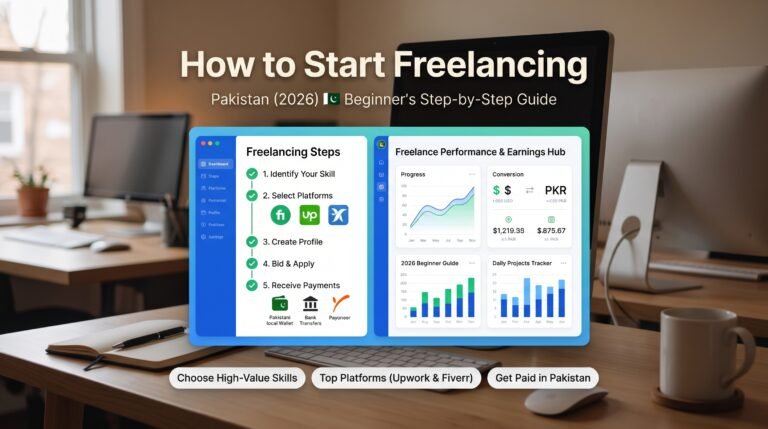
The process is everything around the work: choosing a service, building a Fiverr gig or an Upwork profile, writing proposals, pricing, talking to clients, delivering and getting paid. You can learn it in a few weeks.
The skill is the thing a client pays for: SEO, social media management, video editing, graphic design, web development, writing. That takes months of practice.
A freelancing course teaches the process. If you finish one without a skill to sell, you’ll have a nice profile and nothing to put in it. So when you compare fees, check which of the two a course covers. Some teach only the process. Some teach a skill and add a freelancing module at the end. If you’re still choosing, our guide to the best digital skills to learn in Pakistan will help.
The free options, explained
DigiSkills Freelancing
DigiSkills is a government-backed online training programme, and Freelancing is one of its 24 courses. The course page lists it as free of cost, with a 12-week batch and videos in Urdu and English. It covers the main marketplaces, client hunting, using AI tools, tax and legal matters and how to spot scams.
When we checked on 20 November 2026, the next batch was listed to start on 1 December 2026. You can take up to two courses per batch, so many students pair Freelancing with a skill course such as SEO, Digital Marketing, Graphic Design or WordPress. Those who complete the requirements get an e-certificate from the Virtual University of Pakistan.
e-Rozgaar (Punjab)
e-Rozgaar is run by the Punjab Information Technology Board with the province’s Youth Affairs department. Training is free. It’s aimed at young graduates in Punjab, and past admission notices have asked for a Punjab domicile, 16 years of education, a maximum age of 35 and being unemployed. The rules can change with each batch, so read the current notice on the e-Rozgaar website before you apply.
What free courses can’t do
Free programmes are good, and many working freelancers started with them. Their weak point is personal feedback. Batches are huge. Nobody rewrites your gig title with you or reads the proposal that keeps getting ignored. If you’re self-driven, that’s fine. If you need someone to check your work, it’s where people get stuck.
What a paid freelancing course should include
A paid course has to give you something the free ones don’t. Before you pay, look for these:
- Your own profile reviewed. Not a demo profile on a slide. Yours.
- Both Fiverr and Upwork. They work differently, and most freelancers end up using more than one source of clients.
- Proposal practice. You should write real proposals and get them corrected.
- Client communication. How to reply, how to say no, and how to handle revisions.
- Payments in Pakistan. The legal ways to receive money from abroad, and how to keep records.
- Honesty about income. No guaranteed orders and no promised earnings.
If a course offers recorded videos only, with no review of your work, compare it carefully with the free options. You may not be getting much more.
What freelancing costs after the course
The course fee isn’t the whole budget. Plan for these as well:
- Platform fees. Signing up to Fiverr and Upwork is free, but they take a cut of what you earn. Fiverr keeps 20% of each order. Upwork charges a service fee on your earnings.
- Connects. On Upwork you spend Connects to apply for jobs, and once the free ones run out you buy more.
- Withdrawal charges. Moving money to a Pakistani bank account involves a transfer fee and a currency conversion.
- Tools. Many skills can be learned with free tools at first. Paid ones come later, when clients are covering the cost.
- Laptop and internet. A reliable connection matters more than a fast laptop.
- Time. The first order can take weeks or months. Have a plan for that period.
Promises to be careful about
Freelancing attracts a lot of big claims, and course adverts are full of them. Be careful with anyone who guarantees your first order within a set number of days. Nobody controls that. The same goes for screenshots of dollar earnings used as proof, since they’re easy to borrow or edit.
Stay away from courses that teach you to buy reviews, use fake locations or run several accounts. These break marketplace rules and get accounts banned for good, sometimes with money still inside. And if a course costs more than a full skill course but only teaches account setup, the price is hard to justify.
Free or paid: how to decide
| Your situation | A sensible choice |
|---|---|
| No budget, and you can study on your own | DigiSkills Freelancing plus one DigiSkills skill course |
| Punjab graduate, unemployed, under 35 | Check the current e-Rozgaar admission notice |
| You already have a skill but no clients | A short live freelancing course with profile review |
| No skill yet, and you want guidance | A live skill course first, then freelancing |
Whichever way you go, start with our free guide on how to start freelancing in Pakistan. It walks through the first steps and costs nothing.
Freelancing course fee at Afhaam Academy
Afhaam Academy’s Freelancing with Digital Skills is a 6-week live online course in easy Urdu and English. You choose a service, build a portfolio, publish a Fiverr gig, complete an Upwork profile, and prepare proposal templates and client messages, with your own profile reviewed along the way. Classes are recorded, and there’s no promise of overnight income, only the steps working freelancers follow.
If you need a skill first, the academy also teaches social media marketing, SEO and WordPress website development in live classes. The current fee and the next batch date are shared on WhatsApp. For typical prices of skill courses, see the SEO course fee in Pakistan and the social media marketing course fee in Pakistan.
Ask for the freelancing course fee
Freelancing course fee in Pakistan: common questions
What is the freelancing course fee in Pakistan?
It ranges from free government programmes such as DigiSkills and e-Rozgaar to paid live courses. Skill courses at private institutes cost about PKR 36,000 to 50,000 each. Many academies share their freelancing course fee on request.
Is the DigiSkills freelancing course free?
Yes. The DigiSkills course page lists the Freelancing course as free of cost. It runs for 12 weeks online, with videos in Urdu and English and an e-certificate from the Virtual University of Pakistan.
Can I start freelancing without a paid course?
Yes. Many freelancers start with free courses and practice. A paid course helps when you want your profile, gigs and proposals reviewed by someone experienced.
Which skill is best for freelancing in Pakistan?
Choose a skill that clients pay for and that you enjoy practising, such as social media marketing, SEO, video editing, graphic design or web development.
How long does it take to get the first freelance order?
It is different for everyone and nobody can guarantee a date. A complete profile, good samples and regular proposals improve your chances.
Freelancing course ki fees kitni hai?
DigiSkills aur e-Rozgaar free hain. Private institutes mein aik skill ka course taqreeban PKR 36,000 se 50,000 tak hota hai. Afhaam Academy ki fees WhatsApp par batayi jati hai.
Do I need to pay to join Fiverr or Upwork?
No. Creating an account is free on both. They take a fee from what you earn, and on Upwork you use Connects to apply for jobs.