
Have you ever written a page that used the right keyword in all the right places and still went nowhere? Very often the reason is search intent: the page answered a different question from the one people were really asking. Below you will find what search intent is in SEO, the four types with everyday Pakistani examples, a one-minute way to work out the intent behind any keyword, and how to shape your page around it.
In plain words: search intent (also called user intent) is the reason behind a search: what the person really wants to find, do or buy. The four main types are informational (learn), navigational (go to a website), commercial (compare before buying) and transactional (buy or take action). Google ranks pages that match the intent best, so your page type and content must match it.
What is search intent?
Search intent is the goal a person has when they type a query into Google. When someone searches “SEO course fee in Pakistan”, the words are about a course, but the real intent is to compare prices before deciding. A page that explains the history of SEO will not satisfy them, even if it uses the same words.
In simple Urdu: search intent ka matlab hai search ke peeche ka asal maqsad. Banda Google par kya dhoond raha hai: maloomat, koi khaas website, muqabla ya khareedari?
Understanding intent is basically Google’s whole job. Its own Search Quality Rater Guidelines, the handbook used by people who test Google’s results, asks raters to judge how well a page satisfies the user’s intent. That is why search intent is one of the most important ideas in SEO, together with keyword research.
Why search intent matters in SEO
Intent decides which kind of page is even allowed to rank. If Google only shows course pages for a keyword, your blog post will struggle there, and the other way round. When your page matches, visitors find what they expected, so they stay, read and get in touch instead of bouncing back to Google.
It also decides who you attract. Match buying intent and you get leads; match learning intent and you build trust with people who may buy later. AI answers in Google and ChatGPT work the same way: the page that answers the real question is the one they quote.
The 4 types of search intent (with examples)
1. Informational intent: “I want to learn”
The searcher wants an answer, an explanation or a guide. These are the most common searches. Examples: “what is SEO”, “SEO kya hai”, “how to make a Ghibli photo”, “YouTube monetization requirements”. Best page type: blog posts, guides, how-to articles, videos and FAQs.
2. Navigational intent: “Take me to this website”
The searcher already knows where they want to go. Examples: “Daraz login”, “Fiverr”, “DigiSkills portal”, “Afhaam Academy”. Best page type: your homepage or the exact page they want. You usually only rank for navigational searches about your own brand.
3. Commercial intent: “I am comparing before I decide”
The searcher plans to buy or join, but is still researching options. Examples: “best digital marketing course in Pakistan”, “Gemini vs ChatGPT”, “SEO course fee in Pakistan”, “Hostinger review”. Best page type: comparisons, “best” lists, reviews, fee guides and case studies.
4. Transactional intent: “I am ready to act”
The searcher wants to buy, sign up, book or download now. Examples: “join SEO course online”, “buy domain in Pakistan”, “online Quran classes free trial”, “Canva Pro price”. Best page type: product, course, service or sign-up pages with a clear price or next step.
What about local intent? Searches like “digital marketing course near me” or “SEO course in Hyderabad” add a location. Google then shows maps and local businesses, so a Google Business Profile and a dedicated city page matter. See our digital marketing course in Hyderabad page as an example. Google’s rater guidelines describe these as “Visit-in-Person” queries, alongside “Know”, “Do” and “Website” queries.
| Intent type | What the user wants | Example (Pakistan) | Best page to create |
|---|---|---|---|
| Informational | Learn or understand | what is SEO, SEO kya hai | Guide, how-to, video |
| Navigational | Reach a specific site | DigiSkills login | Homepage, brand page |
| Commercial | Compare options | best SEO course in Pakistan | Comparison, review, fee guide |
| Transactional | Buy or sign up now | join SEO course online | Course, product or service page |
| Local (any type + place) | Find something nearby | SEO course in Hyderabad | City page, Google Business Profile |
How to find the search intent of any keyword
Method 1: Read the keyword itself
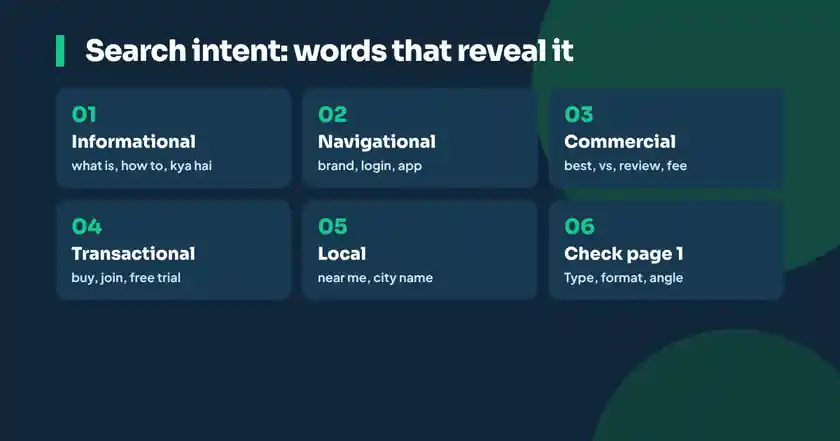
Certain words in a keyword reveal the intent:
| Words in the keyword | Usual intent |
|---|---|
| what is, how to, why, kya hai, kaise, guide, tips, meaning | Informational |
| brand or website name, login, app, portal | Navigational |
| best, top, vs, review, comparison, fee, price list, alternatives | Commercial |
| buy, join, order, download, free trial, coupon, near me | Transactional or local |
Method 2: Google the keyword and study page 1
This is the most reliable method, because Google already shows what it thinks the intent is. Search the keyword (ideally in an incognito window) and look at three things:
- Page type: are the top results blog posts, product pages, course pages, videos or local businesses?
- Format: are they step-by-step guides, lists (“10 best…”), comparisons, reviews or tools?
- Angle: what hook do they use: “for beginners”, “in 2026”, “free”, “in Urdu”, “for Pakistan”?
Also look at the features Google shows. A “People also ask” box and a featured snippet mean informational intent. Shopping results and ads mean commercial or transactional intent. A map with business listings means local intent.
Method 3: Ask what the searcher does next
Imagine the person after they find the perfect page. Do they read and leave with an answer? Compare three options? Fill a form or pay? The next action tells you which page and which call to action you need.
How to match search intent on your page
- Choose the right page type based on what already ranks: a guide for learning keywords, a course or product page for buying keywords.
- Answer the main question in the first lines. Do not make the visitor scroll to find what they came for.
- Cover the follow-up questions. Use “People also ask” and your own customer questions as headings and FAQs.
- Use the format people expect: steps for “how to”, a table for “vs” and “fee”, a list for “best”, and a clear price and button for “join”.
- Match the angle: if top results say “for beginners” or “in Urdu”, your page must clearly serve that audience too.
- Give one clear next step. A related guide for learners, a comparison for researchers, and a sign-up or WhatsApp button for buyers.
Once the page type and structure are right, finish the details with our on-page SEO checklist for beginners.
Search intent example: one topic, three different pages
Take an SEO academy. Lots of people search about SEO, but they want very different things, so one page cannot serve them all. Here is how the same topic splits into separate pages:
| Keyword | Intent | Right page |
|---|---|---|
| what is SEO | Informational | What Is SEO? A complete beginner’s guide |
| how to become an SEO expert | Informational (career) | SEO expert roadmap |
| best SEO course in Urdu | Commercial | A comparison or course overview with what to look for |
| SEO course online join | Transactional | SEO course in Urdu with details and a sign-up form |
Each page links to the next step, so a reader who starts with “what is SEO” can move naturally towards the course when they are ready.
Mixed and changing intent
Some keywords have more than one intent. “SEO course” can mean “teach me SEO for free” or “show me courses to join”. In that case Google shows a mix of results, and the best pages often serve both: a course page with a short explanation, or a guide that clearly offers a course. Intent can also change over time. During Ramadan or exam season, the same keyword may show different results, so check page 1 again before you update an important page.
Search intent in AI search
AI tools such as Google AI Mode and ChatGPT break a question into smaller questions and combine answers from several pages. This makes intent even more important: a page that clearly answers the main question and its follow-ups is more likely to be used as a source. Learn more in SEO vs AEO vs GEO and our guide to Google AI Mode in Urdu.
Common search intent mistakes
- Writing a blog post for a buying keyword where Google only shows product or course pages.
- Pushing a sale on a learning keyword: a page for “what is SEO” that only says “Join our course” will not rank or convert.
- Ignoring the format: writing a long story when everyone ranking uses a quick list or table.
- Assuming instead of checking: always Google the keyword before you write.
- One page for every intent: split very different intents into separate pages that link to each other.
Google’s own advice boils down to one line: create people-first content that leaves the visitor feeling they found what they were looking for. Matching search intent is how you do that.
Learn SEO the practical way
Once you start noticing intent, you see it in every search, and it is one of the clearest differences between a beginner and a good SEO. In Afhaam Academy’s live SEO course in Urdu, you learn to read search results, choose the right page for each keyword and build pages that rank, with practice on real websites. More than 1200 students have already learned digital skills with us.
Want to learn SEO with live practice?
Search intent: common questions
What is search intent in simple words?
Search intent is the real reason behind a search: what the person wants to learn, find, compare or buy when they type a query into Google.
What are the 4 types of search intent?
Informational (learn something), navigational (go to a specific website), commercial (compare options before buying) and transactional (buy or sign up now).
Is search intent the same as user intent?
Yes. In SEO, search intent, user intent and keyword intent all mean the goal behind a search query.
How do I find the search intent of a keyword?
Look at the words in the keyword, such as “how to”, “best” or “buy”, and then Google it and study the type, format and angle of the pages on page 1.
Why is search intent important for SEO?
Google ranks pages that best satisfy what searchers want. If your page type and content do not match the intent, it is hard to rank even with the right keyword.
Can one keyword have more than one intent?
Yes. Some keywords have mixed intent, and Google shows different types of results. In that case, serve the main intent first and link to pages for the others.