Every day, millions of people in Pakistan search on Google for products, services and answers. When your website shows up on the first page for those searches, you get visitors without paying for ads. The skill that makes this happen is called SEO. So, what is SEO exactly, and how does SEO work? This guide to SEO for beginners covers it in plain language: what SEO means, how Google decides who ranks, the free tools worth using and the steps you can take today, even if you have never worked on a website before.
What is SEO?
SEO stands for Search Engine Optimization. It is the process of improving a website so that search engines like Google understand it better and show it higher in search results. Higher rankings mean more people click on your website, and those visitors are free.
Short answer to “what is SEO?”: SEO is the practice of making your web pages helpful, fast and easy for Google to understand, so they rank higher for the words your customers search and bring you free, organic traffic.
Think of Google as a huge library. SEO is how you make sure the librarian knows exactly what your book is about, trusts it, and recommends it to readers who are looking for that topic.
SEO meaning in Urdu
In simple Urdu, SEO ka matlab hai apni website ko is tarah behtar banana ke Google use samajh sake aur search results mein upar dikhaye. In other words, SEO makes your website “Google-friendly”, so that people who search for your topic find you first.
Why SEO matters for businesses in Pakistan
Knowing what is SEO is now important for every business owner, because most people in Pakistan search on their mobile phones before they buy, enroll or call. If your shop, clinic, academy or online store is not on the first page, those customers go to a competitor. SEO helps you:
- Get steady, free traffic instead of paying for every click.
- Build trust, because people believe the top results more than ads.
- Reach buyers at the exact moment they are searching for what you sell.
- Grow a long-term asset: a page that ranks keeps bringing visitors for months or years.
How does Google rank websites?
To understand how SEO works, you first need to know how Google works. Google follows three main steps for every page on the internet:
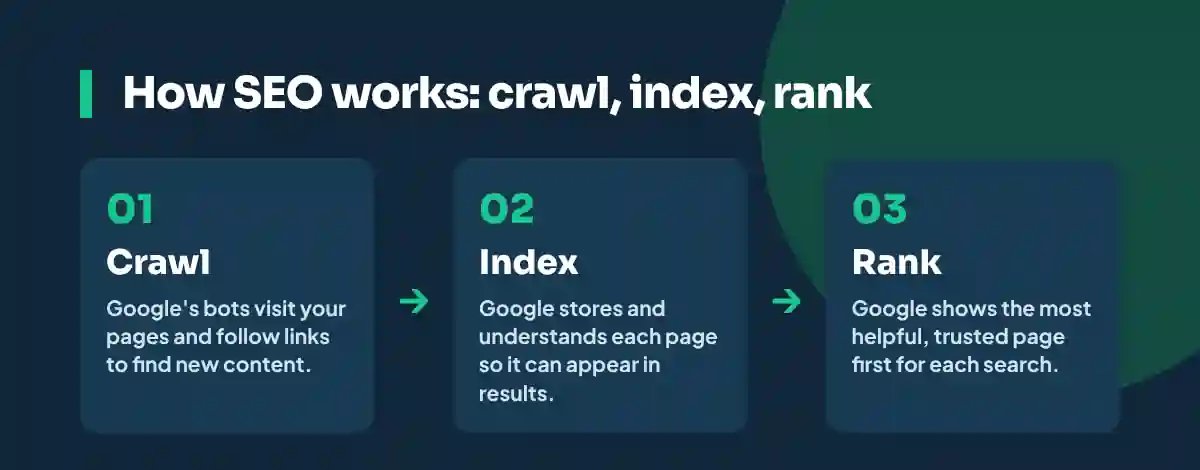
- Crawling: Google’s bots visit pages and follow links to discover new content.
- Indexing: Google stores and organizes the pages it finds, so they can appear in search results.
- Ranking: when someone searches, Google shows the pages it believes are the most helpful, relevant and trustworthy for that search.
Google uses hundreds of signals to decide rankings, but most of them come down to one question: does this page give the searcher the best answer? Google explains this in its own SEO Starter Guide, which is worth reading once you finish this article.
The three types of SEO
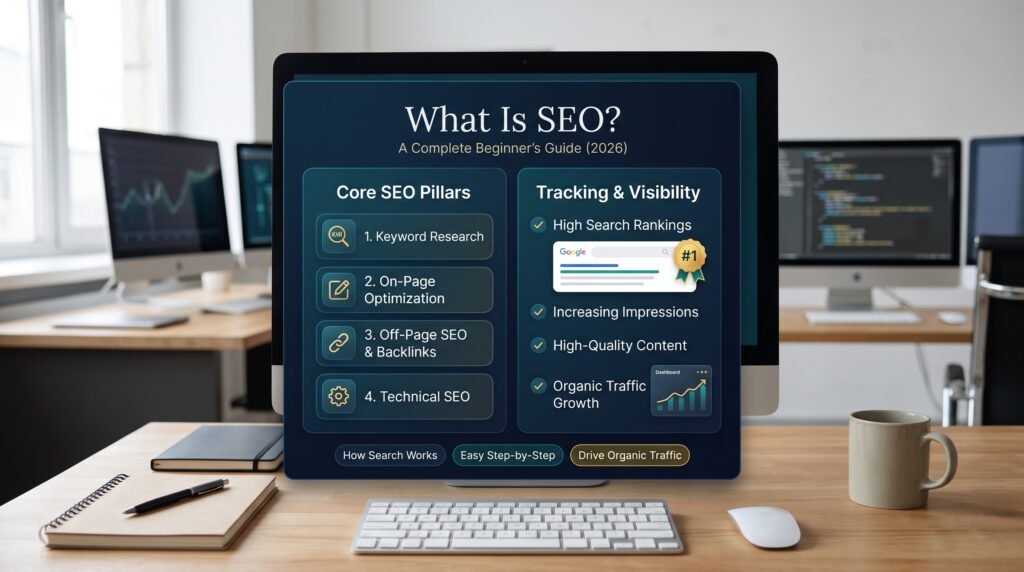
1. On-page SEO
On-page SEO is everything you do on the page itself: choosing the right keyword, writing a clear title and headings, creating helpful content, adding images with descriptive alt text and linking to your other related pages. Use our on-page SEO checklist for beginners to check every page before you publish.
2. Technical SEO
Technical SEO makes sure Google can easily crawl and index your website. It includes fast loading speed, a mobile-friendly design, a secure HTTPS connection, a clean site structure and an XML sitemap.
3. Off-page SEO
Off-page SEO is about building trust from outside your website. The most important part is earning backlinks, which are links from other good websites to yours. For local businesses, a complete Google Business Profile with real reviews also matters a lot.
Want to learn SEO step by step with a mentor?
Keyword research: the starting point
A keyword is the word or phrase people type into Google, such as “online Quran classes for kids” or “best digital marketing course in Lahore”. Good SEO always starts by finding the keywords your audience actually searches. Our step-by-step guide on how to do keyword research shows the full process with free tools.
- Start with Google itself: type your topic and look at the suggestions and the “People also ask” box.
- Use free tools such as Google Search Console and Google Keyword Planner to see what people search and how often.
- Focus on longer, specific phrases first. They have less competition and bring visitors who know what they want.
- Understand the intent: is the person looking to learn, compare or buy? Your page should match that intent. Learn how in what is search intent in SEO.
SEO vs Google Ads: what is the difference?
Both SEO and Google Ads put your website on the search results page, but they work very differently:
| SEO (organic) | Google Ads (paid) | |
|---|---|---|
| Cost per click | Free | You pay for every click |
| Speed | Takes a few months | Starts the same day |
| When you stop | Rankings usually stay for a long time | Traffic stops immediately |
| Trust | Users trust organic results more | Marked as “Sponsored” |
| Best for | Long-term, steady growth | Quick tests and offers |
Most successful businesses use both: ads for quick results and SEO for lasting, low-cost growth.
Important SEO terms for beginners
You will see these words in every SEO guide and tool. Here is what each one means in simple words:
| Term | Simple meaning |
|---|---|
| Keyword | The word or phrase people type into Google, such as “SEO course in Urdu”. |
| Search intent | The reason behind a search: to learn, find a website, compare or buy. See what is search intent. |
| SERP | Search engine results page: the page Google shows after a search. |
| Organic traffic | Visitors who come from normal search results, not from ads. |
| Meta title and description | The blue headline and the short text shown for your page in Google. |
| Backlink | A link from another website to yours. Good backlinks build trust. See our free backlink sites list. |
| Indexing | When Google saves your page so it can appear in search results. |
| Featured snippet | A short answer box Google shows above the normal results. |
| AI Overview | The AI summary Google shows at the top of many results, with links to sources. |
7 SEO steps you can take today
- Pick one main keyword for each page and use it in the title, the first paragraph and at least one heading.
- Write a meta description of around 150 characters that makes people want to click.
- Answer the searcher’s question fully, in simple language, with headings that are easy to scan.
- Compress your images and give each one a short alt text that describes it.
- Link to your related pages, so visitors and Google can find more of your content.
- Check that your website works well and loads fast on mobile phones, since most searches in Pakistan happen on mobile. You can test any page for free with PageSpeed Insights.
- Add your website to Google Search Console and submit your sitemap.
Free SEO tools every beginner should use
- Google Search Console: shows which searches bring people to your site, which pages are indexed and any errors Google finds.
- PageSpeed Insights: measures your page speed on mobile and desktop and tells you what to fix.
- Google Keyword Planner: gives keyword ideas and rough search volumes (free with a Google Ads account).
- Rank Math or Yoast: free WordPress plugins that help you set titles, descriptions and sitemaps without code.
Common SEO mistakes beginners make
- Keyword stuffing: repeating the same keyword again and again makes the page hard to read and can hurt rankings.
- Copying content: Google rewards original, helpful pages, not text copied from other websites.
- Ignoring mobile users: a slow or broken mobile page loses visitors and rankings.
- Buying cheap backlinks: spammy links can do more harm than good. Earn links with useful content instead.
- Giving up too early: SEO takes time. Most beginners stop just before the results start.
SEO, AEO and GEO: SEO in the age of AI
Today people also get answers from Google AI Overviews, Google AI Mode, ChatGPT and Gemini. This has created two new terms. AEO (answer engine optimisation) means writing so your content becomes the direct answer to a question. GEO (generative engine optimisation) means making your brand and content more likely to be cited in AI answers.
The good news for beginners: SEO is still the base of both. Google says its AI features use the same SEO best practices, so a helpful, clear and trusted page has the best chance everywhere. Read the full comparison in SEO vs AEO vs GEO: complete guide, and see what changed for Pakistani searchers in Google AI Mode in Urdu.
How long does SEO take?
SEO is a long-term investment. New websites usually start seeing steady results after a few months of consistent work, while older websites can improve faster. The good news is that once a page ranks well, it keeps bringing visitors every day without extra cost.
Can SEO become a career?
Yes. Every business that has a website needs SEO, which is why SEO specialists are in demand in local companies, agencies and on freelance platforms like Fiverr and Upwork. With practice on real websites and a small portfolio, you can start offering SEO services to clients in Pakistan and abroad. SEO is also one of the best digital skills to learn in Pakistan, because it pairs well with content writing, social media and freelancing.
Your SEO learning path: what to read next
SEO is easier when you learn it in the right order. Follow these free guides one by one:
- SEO basics: you are reading it now.
- Keyword research: how to do keyword research for beginners.
- Search intent: what is search intent in SEO.
- On-page SEO: on-page SEO checklist for beginners.
- AI search: SEO vs AEO vs GEO.
- Career: how to become an SEO expert.
How to learn SEO in Pakistan
You can learn the basics for free from Google’s own guides and YouTube. To become job-ready faster, it helps to learn with a mentor who checks your work on real websites. When you compare options, use our checklist on how to choose the best academy to learn digital skills in Pakistan.
At Afhaam Academy, more than 1200 students have learned digital skills in simple Urdu and English, with live classes and practical projects. You can start with the SEO Mastery course, or learn SEO together with social media and ads in the Complete Digital Marketing course. Not sure which one fits you? Contact us for free counselling.
Keep learning: SEO is one part of a bigger picture, so read our simple guide on what digital marketing is and its main types. If you want to make SEO your career, follow our roadmap on how to become an SEO expert. You can also begin with these free digital marketing courses with certificate, and students in Sindh can join our SEO and digital marketing course in Hyderabad. New on the blog: see how Google AI Mode in Urdu is changing SEO in Pakistan, learn how to start a blog in Pakistan to practise SEO on your own website, and read the YouTube monetization requirements in Pakistan if you want to use SEO for videos too.
Frequently asked questions about SEO
What is SEO in simple words?
SEO (Search Engine Optimization) means improving your website so Google understands it and shows it higher in search results, which brings you free visitors.
What is the meaning of SEO in Urdu?
SEO ka matlab hai apni website ko Google ke liye behtar banana taa ke search results mein aap ki website upar aaye aur logon ko pehle nazar aaye.
How does SEO work?
Google crawls web pages, indexes them and then ranks the most helpful, relevant and trusted pages for each search. SEO improves your pages on all three steps.
What is the first step in SEO?
Keyword research. Find the words your audience types into Google and understand the intent behind them, then build or improve one page for each main keyword.
What is the difference between SEO, AEO and GEO?
SEO helps your pages rank in search results, AEO helps your content become the direct answer in snippets and AI summaries, and GEO helps your brand get cited in AI answers from tools like ChatGPT and Google AI Mode.
Can I learn SEO without coding?
Yes. Most SEO work, such as keyword research, writing content, setting titles and building links, needs no coding. Basic WordPress knowledge is enough to start.
How long does it take to learn SEO?
You can learn the basics in a few weeks. Becoming confident enough to work with clients usually takes two to three months of regular practice on real websites.
Is SEO still worth learning in 2026?
Yes. People still search on Google every day, and AI search tools also rely on well-structured, trusted websites. Businesses keep needing people who can make their websites visible.
Final thoughts
So, what is SEO in one line? It is not magic. It is a set of clear, practical steps: understand what people search, create the most helpful page for that search, make your website fast and easy to use, and build trust over time. Start with the seven steps above, stay consistent, and your rankings will grow.
If you want to learn SEO properly, with live classes, real projects and personal feedback, take a look at our SEO Mastery course.