Type “free backlink sites” into Google and you’ll get list after list. A hundred sites, five hundred sites, and some even promise 1,000 high DR dofollow links. Most beginners do the same thing with these lists. They bookmark one, spend a weekend making profiles on the first twenty sites, check their rankings two weeks later, see nothing, and decide that backlinks don’t work.
The list usually isn’t the problem. What’s missing is the part nobody explains: which of these sites make sense for your kind of website, which links Google actually counts, and how slowly you’re supposed to go.
So this page is a little different. It is a free backlink sites list for 2026, but sorted by what each platform is for. Pick the 15 to 20 that fit you and happily ignore the rest. Further down there’s a quick way to check whether a link is dofollow, a 30-day plan, and the mistakes that land new websites in trouble.
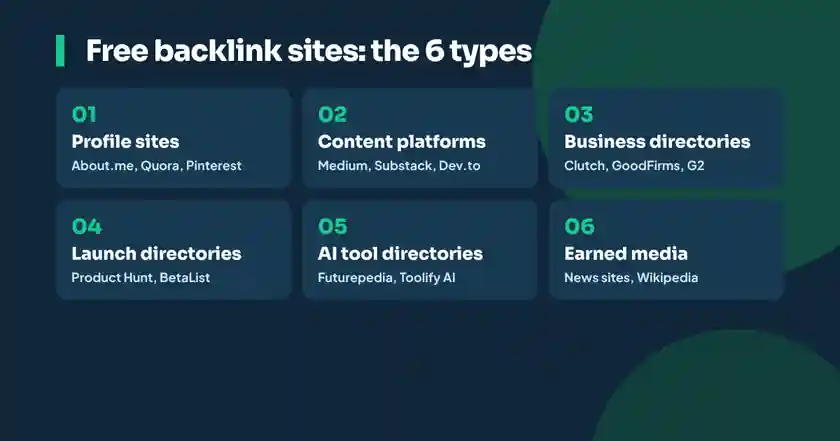
In short: free backlink sites are platforms that let you add a link to your website without paying. Most fall into four groups: profile creation sites (About.me, Quora, Pinterest), content platforms (Medium, Substack), business directories (Clutch, GoodFirms) and launch directories (Product Hunt). They help Google find a new website and make your brand look real. They won’t rank a page by themselves, so think of them as the foundation of your SEO and not the whole building.
What is a backlink, and what does “high DR” mean?
A backlink is simply a link on someone else’s website that points to yours. Search engines read it a bit like a recommendation. If trusted websites point to a page, that page is probably worth showing to people. Backlinks are the biggest part of off-page SEO, which is one of the three parts of SEO covered in our complete beginner’s guide to SEO.
And DR? It stands for Domain Rating, a 0 to 100 score that the SEO tool Ahrefs gives every website, based on how strong that site’s own backlinks are. Moz has its own version called DA (Domain Authority). Keep two things in mind. These scores come from private companies, and Google doesn’t use them. Also, a DR 95 website doesn’t hand you “95 points” through a profile page that nobody visits and nothing links to. DR is good for one job, which is keeping you away from junk sites.
Dofollow vs nofollow: read this before you trust any list
A normal link is what SEO people call dofollow. Google can follow it and count it as a recommendation. A nofollow link has a small tag in its code, rel=”nofollow”, which asks Google not to treat the link as an endorsement. You will also come across rel=”ugc”, used for user-generated content like comments and forum posts, and rel=”sponsored”, used for paid links. Google treats all three as hints and explains them in its guide to qualifying outbound links.
Now, the awkward truth about those “dofollow” lists. Big platforms get spammed all day long, so many of them quietly add nofollow or ugc to whatever links their users post. Wikipedia does it. So do Quora, Reddit and Pinterest. Platforms also change their rules without announcing it, which means a site that gave dofollow backlinks last year may not give them now. When a list says “100% dofollow”, don’t take its word for it.
You don’t have to, because checking a link takes about ten seconds:
- Open the page that has your link, using Chrome on a computer.
- Right-click the link and choose Inspect.
- Read the highlighted line of code. If you see rel=”nofollow”, rel=”ugc” or rel=”sponsored” in it, the link is not dofollow. If none of them is there, it is.
Does that make nofollow sites a waste of time? Not at all. Real websites pick up both kinds of links. And a useful answer on Quora or a good pin on Pinterest can bring you actual visitors. Some of those visitors have websites of their own, and when one of them links to you later, that is the kind of link that moves rankings.
Free backlink sites list by type (2026)
One note before the tables. The DR numbers are approximate, and they move every month. We took them from the Ghulam Ali SEO backlink directory, which sorts 128 platforms into four DR tiers. You won’t find all 128 below. We kept the ones that are worth a beginner’s time and grouped them by what you can actually do on each site, because that tells you far more than the score does.
1. Profile creation sites (anyone can use these)
Profile creation sites let you make a public profile with a short bio and a link to your website. Nothing is easier to set up, which makes them the natural first step for a brand-new site. For a longer list and the exact steps, see our profile creation sites list.
| Site | DR (approx.) | What to add |
|---|---|---|
| 97 | A business profile with your website, then pins that link to your posts | |
| GitHub | 97 | A profile with the website field filled in. Mostly useful for developers |
| 95 | A profile link. Join communities in your field and help people before you share anything | |
| Flickr | 94 | A profile, plus your own photos or graphics |
| Patreon | 93 | A creator page, if you make content that people support |
| Gumroad | 92 | A seller profile, if you sell digital products |
| Quora | 91 | A profile with a bio and a link. Answer questions in your field |
| 500px | 90 | A photography profile |
| About.me | 90 | A one-page personal profile with a button to your website |
| Wellfound | 87 | A company or professional profile, for startups and job seekers |
| Muck Rack | 85 | A portfolio profile, for writers and journalists |
| Indie Hackers | 81 | A founder profile and a page for your product |
| Peerlist | 77 | A professional profile, for people in tech and design |
One more thing. The four profiles that matter most for a business in Pakistan never appear in DR lists at all: your Google Business Profile, Facebook page, LinkedIn page and YouTube channel. Set those up before anything in the table.
2. Content platforms (publish an article, link back)
On these platforms you can publish a full article. If you only have time for one thing this month, write one useful article with a relevant link. It will do more for you than ten empty profiles.
| Site | DR (approx.) | Best for |
|---|---|---|
| GitHub Pages | 97 | A small free website hosted from a GitHub account |
| Medium | 94 | General articles on almost any topic |
| Substack | 94 | A newsletter with public posts |
| Beehiiv | 91 | Newsletters |
| Dev.to | 91 | Developer and tech tutorials |
| HackerNoon | 87 | Tech stories. Editors review each one before it goes live |
| Hashnode | 83 | Developer blogs |
| Vocal Media | 82 | Stories and articles for general readers |
Write a fresh piece for each platform, somewhere around 800 to 1,200 words. Posting the same article on five sites is tempting, but copied text does nothing for you. Link once or twice to the page on your own site that covers the topic in more depth, and leave it at that.
3. Business and agency directories
Selling a service? Directories put your name in front of people who are already comparing providers.
| Site | DR (approx.) | Who can list |
|---|---|---|
| Clutch | 91 | Agencies and service companies (marketing, web, IT). Client reviews matter a lot here |
| G2 | 91 | Software products |
| Capterra | 91 | Business software |
| GoodFirms | 86 | IT and marketing companies |
| TrustRadius | 84 | Business software |
Clutch and GoodFirms are a good fit for agencies, and for freelancers who operate as a company. G2, Capterra and TrustRadius are for software only. No software, no listing.
4. Launch and software directories
Look closely at any high DR backlinks list and you’ll notice that a big chunk of it is startup launch sites. These only help if you have built a product, meaning an app, a SaaS tool, a plugin or a browser extension. If that’s you, these are the ones to look at, with approximate DR in brackets:
- Big names: Chrome Web Store (99, only if you publish a Chrome extension), SourceForge (93), Product Hunt (91)
- Software listings: AlternativeTo (79), SaaSHub (79), StackShare (79)
- Launch platforms: Fazier (82), BetaList (76), Uneed (75), TinyLaunch (72), SideProjectors (70)
- Smaller communities: DevHunt (63), Microlaunch (61), StartupBase (60)
5. AI tool directories
If you have built an AI tool, these directories will list it by category: There’s an AI for That (77), Toolify AI (73), Futurepedia (72), Open Tools (68), AI Agent Store (59) and AIxploria (55). Haven’t built one? Then skip this group completely.
6. Famous sites you cannot simply “submit” to
Wikipedia (97), Forbes (94), TechCrunch (92), VentureBeat (91), wikiHow (91) and Hacker News (91) show up in a lot of lists, mostly because the names look impressive. But think about it for a second. You can’t open a profile on Forbes and drop your link there. News sites write about you when you have a real story, and getting that story in front of them is PR work. Wikipedia editors delete promotional links, and whatever survives is nofollow anyway. Hacker News buries self-promotion quickly. Treat these as long-term goals. They don’t belong on a submission checklist.
Which free backlink sites should you use?
You don’t need all of these. Nobody does. Find the row that sounds like you and start there.
| You are | Start with |
|---|---|
| A student or freelancer building a personal brand | About.me, LinkedIn, Quora, Medium, Peerlist |
| A local business (shop, clinic, academy) | Google Business Profile, Facebook page, Pinterest, YouTube, Quora |
| A blogger | Pinterest, Medium, Substack, Quora, Reddit communities in your niche |
| An agency or service company | Clutch, GoodFirms, LinkedIn page, Medium, Wellfound |
| A developer | GitHub, Dev.to, Hashnode, Indie Hackers |
| A software or AI tool maker | Product Hunt, AlternativeTo, SaaSHub, BetaList, then the AI directories |
How to create a profile backlink that is worth having
A profile with a link and nothing else is exactly what spam looks like. Spend ten more minutes on it and it looks like a real business instead. This is where those ten minutes should go:
- Use the same name everywhere. Your brand name, phone number, city and website address should be spelled the same way on every site. If one profile says “ABC Academy Sukkur” and another says “A.B.C. Tuition Centre”, Google has a harder time seeing them as one business.
- Fill in everything. Logo or a real photo, category, location, social links, and a bio written fresh for that site.
- Write the bio for people. Two or three sentences on what you do and who you help. One keyword is fine. A string of keywords is not.
- Link to the page that fits. For a general profile that is your homepage. Where the context is specific, link to the matching service page or article.
- Add one useful thing. An answer, a pin, a photo, a short post. Google often doesn’t bother to index empty profiles, and a page that isn’t indexed passes nothing on.
- Keep a record. A simple sheet with the site, profile URL, login email and date is enough. You will thank yourself the day your phone number or address changes.
Anchor text and pace: how to stay safe
Anchor text is the clickable part of a link. Imagine every single link to a new website saying “best SEO course in Pakistan”. It looks arranged, because real people don’t link that way. They use your name, or they just paste the URL. A common rule of thumb, which the directory above recommends too, is roughly 60% brand name (Afhaam Academy), 25% plain URL (afhaamacademy.com) and 15% descriptive phrases (SEO course in Urdu). Don’t sit with a calculator over it. Just make sure your brand name is what shows up most.
Speed is the other thing to watch. Fifty new profiles in one weekend on a month-old domain is a pattern, and spotting patterns is what spam systems are built for. Treat one or two links a day as the ceiling. Honestly, three to five good ones a week is plenty for a small website. Google’s spam policies say plainly that links made mainly to manipulate rankings count as link spam. Slow and real wins here.
A 30-day plan for your first free backlinks
If you would like something to follow, here is a simple month:
| Week | Focus | What to do |
|---|---|---|
| Week 1 | Foundation | Google Business Profile, Facebook, LinkedIn and YouTube first. Then About.me, Quora and Pinterest. Complete every profile properly. |
| Week 2 | Content | Publish one original article on Medium and one on Substack or Vocal Media. Answer five questions on Quora in your field. |
| Week 3 | Directories | Add the two or three directories that match your type of business. Ask two happy clients for a review, where the site allows it. |
| Week 4 | Review | See which profiles Google has indexed and fix the incomplete ones. Then open the Links report in Google Search Console to see which links Google has found. |
Count them up and you get 12 to 15 links in a month. Not 128. That is deliberate. If Search Console is new to you, our Google Search Console tutorial will get you started.
Mistakes that waste your time (or hurt your site)
The most expensive mistake is also the most common one: buying a “5,000 backlinks” gig. What you get is automated links from junk sites. If you are lucky, Google ignores them. If you are not, a new domain can be damaged before it has ranked for anything.
The second is making profiles and never going back to them. A profile with no activity rarely gets indexed, so the hour you spent on it is gone. Copy-pasting one bio everywhere belongs in the same category. Rewrite it each time, even if you only change a few sentences.
Then there is chasing DR. A DR 60 site from your own industry is worth more to you than a DR 90 photo site you have no reason to be on. And finally, patience. New links take weeks to be found and counted, and when the effect comes, it comes slowly.
What free backlink sites cannot do
Now for the limits. Profile and directory links are easy to get. That is their weakness too, since your competitors can get the very same links in an afternoon. They help Google find a new website and trust it a little. What they almost never do is lift a page from position 40 into the top 5. That job belongs to editorial links, where another site owner decides to link to you because your page was useful to their readers.
So most of your effort should go into being worth linking to. Publish pages that answer real questions better than whatever ranks today. That starts with keyword research and a careful pass through the on-page SEO checklist. Give people something to cite, like your own numbers, a local price guide, a template or a free tool. Write a guest article now and then for a blog in your field, and get to know other site owners. And if you don’t have a website yet, begin with how to start a blog in Pakistan.
Learn link building with practice
Link building is part of Afhaam Academy’s SEO course in Urdu, along with keyword research, on-page SEO and technical SEO, all taught in live online classes. Thinking about SEO as a career? Our roadmap on how to become an SEO expert lays out the whole path.
Want to learn SEO and link building step by step?
Free backlink sites: common questions
What are free backlink sites?
Free backlink sites are platforms where you can add a link to your website without paying, such as profile sites, content platforms, business directories and launch directories. They help a new website get discovered, but they only work well alongside good content.
What are profile creation sites?
Profile creation sites are websites where you can make a public profile with a bio and a link to your website, for example About.me, Quora, Pinterest and GitHub. For a new website they are the simplest way to get your first backlinks.
Are profile backlinks still useful in 2026?
Yes, as a foundation. They help Google connect your brand across the web and can send some visitors. On their own they are not strong enough to rank a competitive page, so combine them with helpful content and earned links.
How many backlinks should I create per day?
For a new website, one or two a day is a sensible upper limit, and three to five good links a week is enough for most small sites. A sudden burst of links on a young domain looks unnatural.
Are all high DR backlinks dofollow?
No. Many high DR platforms, including Wikipedia, Quora, Reddit and Pinterest, add nofollow or ugc tags to links that users post. Right-click the link and choose Inspect to check the rel attribute yourself.
Can free backlinks harm my website?
Links from real, relevant platforms will not harm you. The risk comes from bulk automated links, paid link packages and keyword-stuffed anchor text, which Google treats as link spam.
Backlinks kaise banaye?
Sab se pehle apni website par acha content likhein. Phir About.me, Quora, Pinterest aur Medium jaisi sites par mukammal profile banayein aur apni website ka link lagayein. Rozana 1 ya 2 se zyada links na banayein, har jagah brand ka naam aik jaisa rakhein, aur paid ya automated backlinks se door rahein.
How long do backlinks take to work?
Google first has to crawl and index the page that holds your link, which can take from a few days to several weeks. Any ranking effect builds slowly after that, so judge link building over months, not days.