
A few years ago, SEO meant one thing: get your page into Google’s top ten. Now people also get answers from Google AI Overviews, AI Mode, ChatGPT, Gemini and Perplexity, often without clicking anything. Two new terms have arrived with this change, AEO and GEO, along with a lot of confusion. This SEO vs AEO vs GEO guide explains each one in plain language, where they differ, where they overlap, and one practical plan that covers all three in 2026.
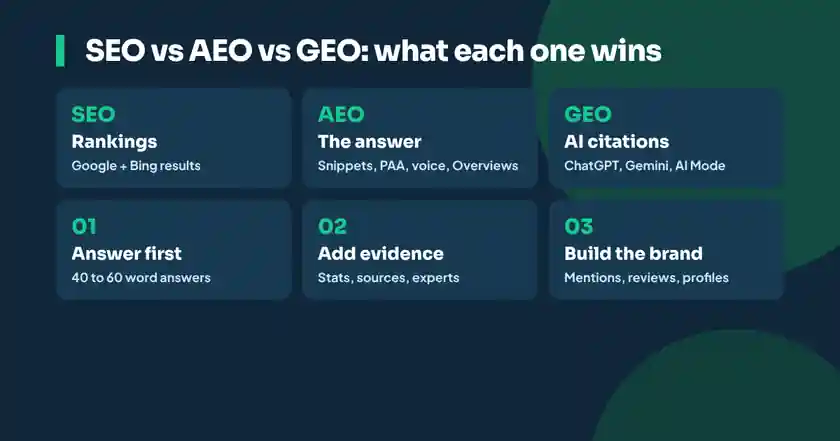
If you are short on time: SEO (search engine optimisation) helps your pages rank in search results. AEO (answer engine optimisation) helps your content become the direct answer, such as a featured snippet, a “People also ask” answer or a voice answer. GEO (generative engine optimisation) helps your brand and content get cited or mentioned in AI-generated answers from tools like ChatGPT, Gemini, Perplexity and Google AI Mode. They are not rivals: good SEO is the base of all three.
SEO vs AEO vs GEO at a glance
| SEO | AEO | GEO | |
|---|---|---|---|
| Full form | Search Engine Optimisation | Answer Engine Optimisation | Generative Engine Optimisation |
| Main goal | Rank pages high in search results | Be the direct answer to a question | Be cited or mentioned in AI answers |
| Where it shows | Google and Bing results | Featured snippets, People also ask, voice assistants, AI Overviews | ChatGPT, Gemini, Perplexity, Copilot, Google AI Mode |
| Success looks like | Rankings, clicks, organic traffic | Your answer shown at the top or read aloud | Your brand named or linked in the AI reply |
| Key tactics | Keywords, on-page, technical SEO, backlinks | Question headings, short direct answers, FAQs, structured data | Clear facts, statistics, sources, expert quotes, brand mentions across the web |
| How to measure | Search Console, analytics | Search Console, checking snippets manually | AI referral traffic in analytics, manual prompt checks, brand mentions |
What is SEO?
SEO is the practice of improving your website so search engines understand it, trust it and rank it higher for the searches your audience makes. It covers keyword research, on-page SEO, technical SEO and off-page SEO like backlinks. SEO is still where most website traffic in Pakistan comes from, and every AI search tool depends on websites that are crawlable and trustworthy. If you are new, start with our complete beginner’s guide to SEO.
What is AEO (answer engine optimisation)?
AEO is the practice of shaping your content so that search engines and assistants can lift it as the answer to a question. The term became popular with featured snippets and voice search: when you ask Google Assistant or Siri a question, it reads out one answer. Today AEO also includes Google AI Overviews, the AI summary that appears at the top of many results.
AEO works best for clear questions: “SEO kya hai?”, “how long does SEO take?”, “YouTube monetization requirements”. To win them, you give a short, direct answer (40 to 60 words) right below a question-style heading, then explain in detail.
AEO in practice
- Use the exact question as an H2 or H3 heading.
- Answer it in the first one or two sentences, in plain language.
- Use lists for steps and tables for comparisons, so Google can show them as snippets.
- Add an FAQ section with real customer questions and short answers.
- Add FAQ, HowTo, Article or LocalBusiness structured data where it fits (Rank Math can do this).
What is GEO (generative engine optimisation)?
GEO is the practice of making your content and brand more likely to be used, cited and recommended by generative AI: large language model tools such as ChatGPT, Gemini, Perplexity, Microsoft Copilot and Google AI Mode. These tools write a new answer by combining information from many sources, and often show links to the pages they used.
The term comes from a 2023 research paper from Princeton University and partners, published at the KDD 2024 conference. The researchers found that the right changes to a page can boost its visibility in AI-generated answers by up to 40%. The methods that worked best were adding citations to sources, adding quotations from experts and adding statistics. Old-style keyword stuffing did not help at all, and in some tests made results worse.
GEO in practice
- Be specific and factual: real numbers, dates, prices and examples are easier for AI to quote than vague claims.
- Cite your sources: link to official and original data.
- Show expertise: named authors with real experience, expert quotes and original insights.
- Get mentioned elsewhere: AI tools learn which brands to trust from news sites, directories, YouTube, Reddit, Quora and reviews, not only from your own website.
- Stay consistent: the same business name, description and details everywhere online, so AI tools connect them to you.
- Let AI crawlers read your site: do not block them in robots.txt unless you have a reason, and keep key information in plain text, not only in images.
SEO vs AEO vs GEO: how they overlap
A simple way to picture it is a three-storey building. SEO is the foundation: if Google cannot crawl, index and trust your page, it will not appear in snippets or AI answers either. AEO is about structure: clear questions and direct answers. GEO is about authority and evidence: facts, sources and a brand the internet talks about.
Google itself is quite direct about this. According to Google’s guide to AI features and your website, there are no extra requirements to appear in AI Overviews or AI Mode, and the same SEO best practices apply. So you do not need three separate strategies. You need good SEO, written in an answer-first way, backed by real expertise.
Why this matters in Pakistan right now
In May 2025 Google expanded AI Overviews to more than 200 countries and territories. Then AI Mode reached Pakistan in August 2025, and Google added Urdu support in October 2025, so millions of Pakistanis can now ask long questions in Urdu and get AI answers with links. We explain this change in detail in Google AI Mode in Urdu: what it means for SEO.
What does that mean for a business? Mostly two things. Fewer people will click through ten results, because AI compares options for them. But the websites AI chooses to cite get visitors who are further along in their decision. And because good Urdu and Roman Urdu content is still rare, Pakistani websites that answer local questions well have a real chance to become the go-to source.
One plan for SEO, AEO and GEO: 10 steps
- Research real questions. Use Google autocomplete, People also ask and your customers’ WhatsApp messages. Our keyword research guide shows how.
- Match the search intent. Build the page type people expect. See what is search intent in SEO.
- Answer first. Put a 40 to 60 word direct answer at the top and under each question heading.
- Structure for skimming. Question-style headings, short paragraphs, numbered steps, tables and FAQs.
- Add evidence. Statistics, dates, prices, examples and links to original sources.
- Show who you are. A named author with a short bio, real photos and your own experience.
- Get the basics right. Follow our on-page SEO checklist: titles, URLs, speed, mobile, internal links and structured data.
- Build your brand off-site. A complete Google Business Profile, reviews, social profiles, directory listings and mentions on trusted sites.
- Write for local and Urdu searchers. Add city pages and Urdu or Roman Urdu answers where your audience uses them.
- Keep it fresh. Update facts, prices and years, because AI tools prefer current, reliable information.
SEO vs AEO vs GEO example: one question, three kinds of visibility
Take the question “Hyderabad mein digital marketing course kahan se karein?”
- SEO: a city page like our digital marketing course in Hyderabad page ranks in the normal results.
- AEO: a clear FAQ answer on that page (“You can join online live classes or a campus institute. Online classes save travel time and…”) appears in “People also ask” or a featured snippet.
- GEO: when someone asks ChatGPT or Google AI Mode the same question, the AI mentions the academy because its website, Google Business Profile, reviews and social profiles all describe the same courses clearly.
How to measure AEO and GEO results
- Google Search Console: AI Overviews and AI Mode clicks and impressions are included in the Performance report, under normal web search.
- Analytics referrals: in Google Analytics, look for visits from chatgpt.com, perplexity.ai, gemini.google.com and copilot.microsoft.com.
- Manual checks: every month, ask ChatGPT, Gemini, Perplexity and Google AI Mode 10 questions your customers ask, and note whether your brand is named or linked.
- Brand searches: growth in people searching your brand name is often a sign that AI tools and other sites are mentioning you.
Four myths worth ignoring
- “SEO is dead.” AI tools still need websites to learn from and cite. SEO is the base they build on.
- “You need special AI files or tags.” Google says you do not need new machine-readable files, AI text files or special markup to appear in its AI features. Proposals like llms.txt are optional extras, not a requirement.
- “Write for robots, not people.” AI tools reward clear, helpful, trustworthy content, the same things people value.
- “AEO and GEO are only for big brands.” Small, local and Urdu-language websites can win because they answer specific questions better.
Learn SEO for Google and AI search
If you remember one thing from this SEO vs AEO vs GEO guide, make it this: AEO and GEO do not replace SEO, they are SEO done with more care. The surest way to stay relevant is to learn SEO properly and understand how AI search uses it. Afhaam Academy’s SEO course in Urdu covers keyword research, on-page and technical SEO, local SEO and optimising for AI search, in live online classes with practice on real websites. More than 1200 students have learned digital skills with us. Thinking of SEO as a career? Read how to become an SEO expert.
Learn SEO, AEO and GEO with a mentor
SEO vs AEO vs GEO: common questions
What is the difference between SEO, AEO and GEO?
SEO helps your pages rank in search results, AEO helps your content become the direct answer in snippets and voice or AI summaries, and GEO helps your brand get cited in AI-generated answers from tools like ChatGPT, Gemini and Google AI Mode.
What is AEO in SEO?
AEO, or answer engine optimisation, means structuring content with clear questions and short direct answers so search engines and assistants can show it as the answer, for example in featured snippets, People also ask or AI Overviews.
What is GEO in digital marketing?
GEO, or generative engine optimisation, means making your content and brand more likely to be used and cited by generative AI tools, using clear facts, statistics, sources, expertise and brand mentions across the web.
Is GEO replacing SEO?
No. AI search tools rely on websites that are crawlable, indexed and trusted. Google says the same SEO best practices apply to its AI features, so SEO remains the foundation of GEO.
How can I get my website mentioned by ChatGPT?
Publish clear, factual and up-to-date content, answer real questions directly, cite sources, show expertise, keep your business details consistent online and earn mentions on trusted websites, directories and social platforms.
Do I need to learn AEO and GEO separately?
Not really. If you learn SEO well and write in an answer-first, evidence-based way, you are already doing most of AEO and GEO. A good SEO course in 2026 should cover all three.